Energy & AI Infrastructure
Multi-Manufacturer Fleets Are the Unsexy Reason Renewables Don't Scale — and the AI Opportunity Hiding Inside Them
Every utility-scale operator owns inverters from four to seven OEMs across a portfolio. Each speaks its own protocol, portal, and alarm taxonomy. The integration layer is where AI earns its keep — not in prediction, in translation.
By Tom Hanks· June 2026· 6 min read
Ask most people what AI will do for renewables and they'll reach for one word: predict. Forecast the failure before it happens, optimize the output, all the sci-fi stuff. It's a beautiful promise, and I understand why it captivates. But let me ask the operator standing in front of six monitoring portals a fairer question: before you can predict tomorrow's failure, can you even read today's? If you can't say what's broken right now without translating six vendors' dialects, what would a prediction actually add?
That's why I want to talk about something far less glamorous, and far more valuable, than prediction: translation. Because the real reason a utility-scale operator's day is hard isn't that the future is unknowable. It's that the present is unreadable.
A large portfolio typically runs inverters from several different manufacturers — in my experience, four to seven, an estimate the market structure makes easy to believe (more on that below). Each brand speaks its own dialect, ships its own portal, and names its faults its own way. Before anyone can fix what's broken, someone has to figure out what “broken” even means this time — across half a dozen systems that can't agree on vocabulary.
The Tower of Babel, with inverters
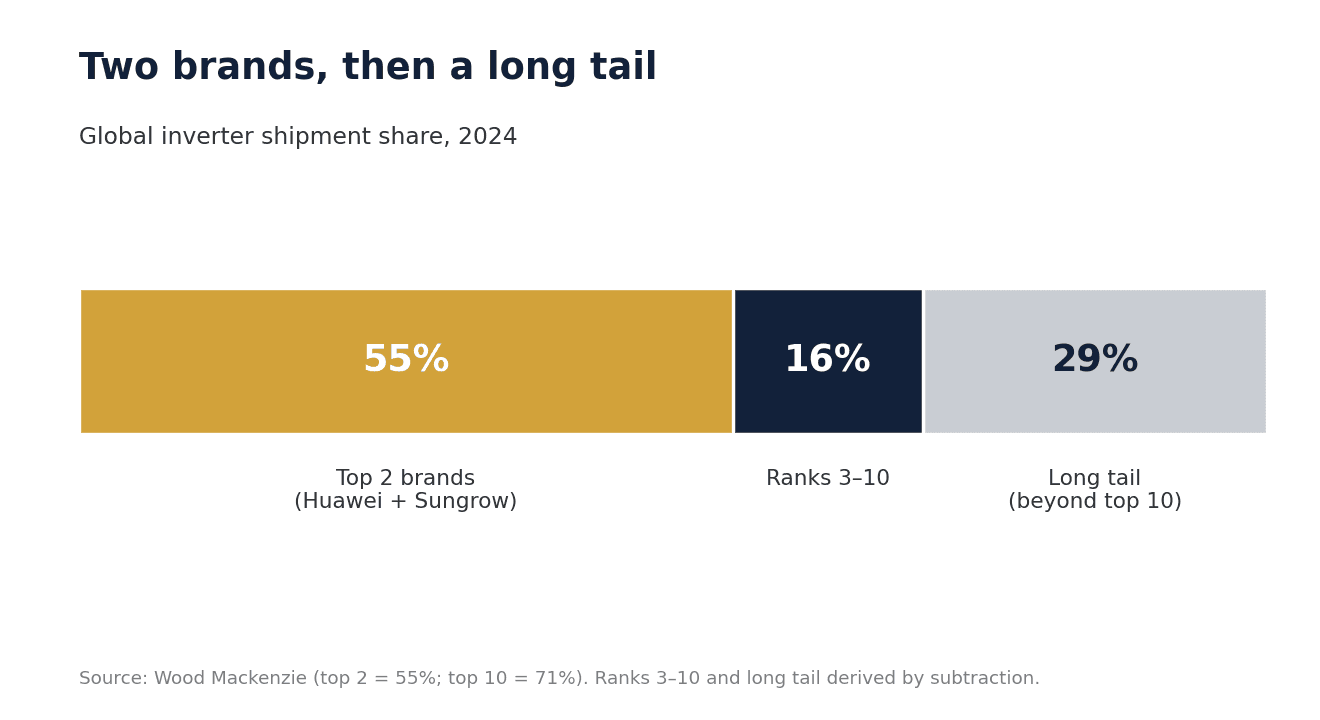
Why so many brands? Because the inverter market is genuinely fragmented. Wood Mackenzie's ranking evaluates 23 leading manufacturers, and while Huawei and Sungrow together hold about 55% of global shipments, the top ten vendors account for only 71% of the market — leaving a long tail of brands that any large operator inevitably accumulates through acquisitions, repowering, and supply decisions made years apart.
Each of those brands is its own little island. As asset managers will tell you, heterogeneous hardware creates “isolated data silos,” forcing teams to navigate multiple, disparate manufacturer portals just to assemble a single view of a single portfolio. One inverter stores “state of charge” at one register address; another keeps the same value somewhere else entirely. The same physical fault might be “Error 14” on one brand and “DC isolation fault” on the next. The machines are all doing roughly the same job. They just refuse to describe it the same way.
This is a translation cost, not a technology gap
Here's the part the industry has been oddly quiet about: the protocols to fix this largely exist. The SunSpec Alliance built an open Modbus standard back in 2009, and it's now referenced in IEEE 1547-2018 and written into national grid codes. The U.S. Department of Energy and SunSpec, alongside more than 350 companies, created Orange Button specifically to standardize solar data taxonomy and “decrease long-term costs.” When the federal government helps fund a national data-standard program, you know the translation problem was expensive enough to be a matter of public interest.
And yet the islands persist. Why? Because, as EPRI bluntly notes, “even when protocols are implemented properly, there are other non-standardized practices that can lead to barriers” — custom control algorithms, proprietary tweaks, and alarm taxonomies no two vendors define the same way. Standards narrow the chaos; they don't erase it. IEEE 1547 didn't pick one protocol — it allowed four. Four translators is better than fourteen. It's still four.
Why this is the AI opportunity — the real one
Now the good part. For most of computing history, reconciling these mismatched dialects was brutal, bespoke engineering: someone hand-mapped every register, every alarm code, every quirk, and redid it whenever a firmware update moved the furniture. This is exactly the kind of work large language models turn out to be unreasonably good at. A growing body of peer-reviewed research shows LLMs applied to schema matching and entity resolution — the precise task of recognizing that “state of charge at register 40100” and “SoC at register 50220” are the same real-world concept.
That's the opportunity, and notice what it is: not prediction, translation. You cannot predict, optimize, or automate a fleet you cannot first read.
An AI that reads every OEM's dialect and renders it into one clean, normalized language — one taxonomy, one alarm set, one view — does something prediction can't. It makes the present legible.
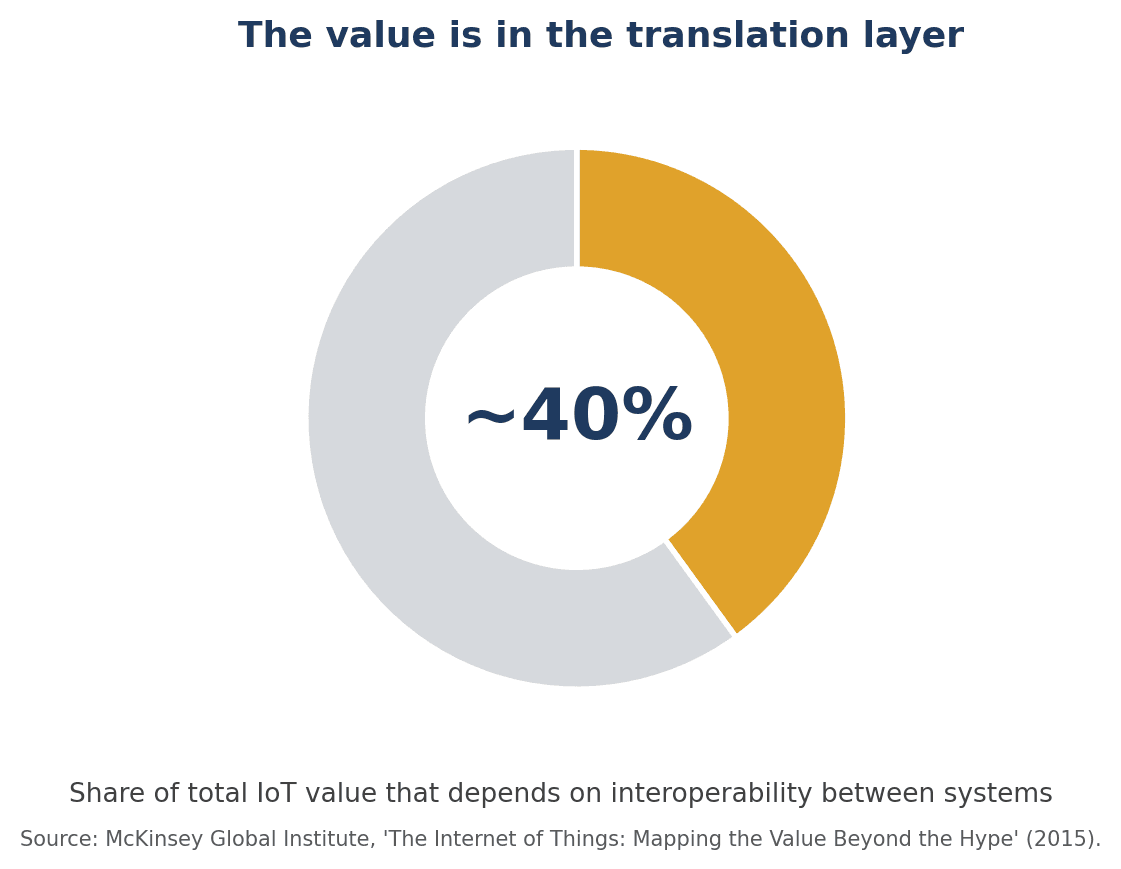
How big is that prize? McKinsey's landmark IoT study found that interoperability — systems' ability to talk to each other — is required for roughly 40% of the total economic value of IoT applications. Forty percent of the value isn't in the sensors or the analytics. It's in getting the pieces to understand one another. In renewables, that 40% is sitting in plain sight, locked behind six incompatible portals.
The unsexy math of getting there
Consider the downstream cost. Power Factors offers a tidy example: a remote plant that loses a 500 kW inverter at a $0.10/kWh PPA bleeds roughly $180 a day, so a $1,500 truck roll takes about eight days to pay back. But that's the cost of fixing a fault you've already correctly diagnosed. The hidden cost — the one nobody budgets — is the labor to figure out which portal, which alarm code, and which actual failure you're dealing with, across a fleet that won't speak a common language. Translation is the upstream tax on every single thing you do next.
This is why I think the most valuable AI in renewables won't be the model that predicts a failure six weeks out. It'll be the unglamorous layer that, the moment any device on any brand throws any fault, tells a human in plain English what happened, where, how bad, and what to do — having quietly reconciled six vendors' worth of gibberish to get there.
If you could either perfectly predict next quarter's failures or perfectly understand today's, across every brand you own — which would actually change your operation more?
The industry loves to frame AI as a crystal ball. I'd argue its first and best job in renewables is humbler, and far more powerful: to be a universal translator — the thing that finally lets a hundred-megawatt fleet of mismatched machines tell one coherent story. It's not the demo that earns applause at the conference. It's the one that makes every other promise — prediction included — finally possible. My money's on translation; I hold that strongly, and lightly enough to be talked out of it. But I'd start the argument here: which would you rather have — a crystal ball you can't yet trust, or a fleet you can finally read? The operator who can read theirs is going to outrun the one still waiting on a prophecy.
References & Sources
The “four to seven OEMs per portfolio” figure is the author's field estimate, consistent with the fragmentation data cited (Wood Mackenzie evaluates 23 named vendors; the top 10 hold only 71% of shipments). In Figure 2, the top-2 (55%) and top-10 (71%) shares are reported by Wood Mackenzie; the intermediate and long-tail shares are derived by subtraction. All figures are original graphics by the author, built from the cited data.
-
Wood Mackenzie, “Huawei and Sungrow lead global solar inverter market share in the first half of 2025” (top 10 = 71%; top 2 = 55%).
-
SunSpec Alliance, “Modbus” (open standard referenced in IEEE 1547-2018).
-
SunSpec Alliance & U.S. Department of Energy, “Orange Button” solar data standard. See also energy.gov — Orange Button solar data standard.
-
EPRI, “Assessment of Interoperability Achieved through IEEE Std 1547” / DER Integration Toolkit.
-
McKinsey Global Institute, “The Internet of Things: Mapping the Value Beyond the Hype” (June 2015).
-
“Schema Matching with Large Language Models: an Experimental Study,” VLDB 2024 (TaDA workshop).
-
Energis.Cloud, “Solar Asset Management” (on heterogeneous hardware and isolated data silos).