AI in Public Safety & Surveillance
From Watching to Understanding: The Quiet Boom in Public-Safety AI
In barely a decade, cameras stopped recording and started reasoning. Real-time crime centers grew from a handful to 130-plus, police drone programs multiplied, and license-plate readers now scan billions of vehicles a month — a build-out as fast as it is unexamined. The scene-setter: the scale, the technology, and why the inflection is happening now.
By Tom Hanks· June 2026· 10 min read
There has always been a camera. On the bank, over the register, at the intersection. We made our peace with that lens a long time ago, and the peace was easy because the lens was dumb. It watched, it forgot, and on the rare day something happened, a detective spent a week scrubbing grainy tape to find the four seconds that mattered. The camera was a witness with no memory and no opinion. That is the surveillance most of us still picture when we picture surveillance.
So when someone says there are more cameras now, the honest reaction is a shrug. Of course there are more. There are more of everything. It's a fair instinct, and for most of the camera's history it was the right one — the change was always quantity, never kind. But sit with three questions. If today's system is just more of the old one, why can a single officer now search tens of thousands of cameras in the time it takes to type a license plate?¹ Why did the count of agencies running centralized "real-time crime centers" jump by roughly 148% in four years, after decades of barely moving?² And why does a drone now arrive at the 911 call before the patrol car — and sometimes find the person before the humans have left the building?³
Here's the truth those questions point at, and it is not the one we rehearsed. The shift of the last decade was never about more cameras. It was about cameras that understand what they see. The lens stopped being a witness with no memory and became something closer to an analyst who never sleeps, never blinks, and never forgets a face, a plate, or a path. That is a difference in kind, not degree — and it happened quietly, while we were still arguing about the old thing.
The scale, in case you missed it
You're forgiven for missing it, because it didn't arrive as a single announcement. It accumulated.
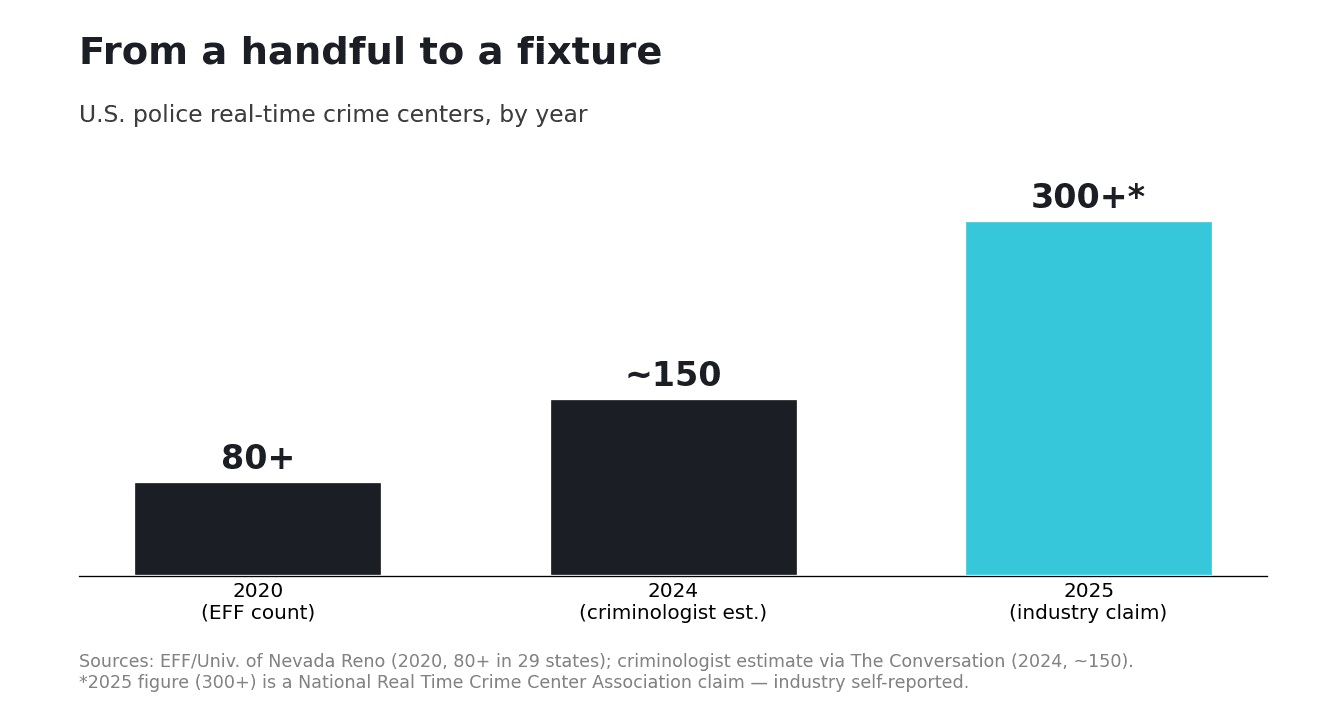
Start with the nerve centers. The "real-time crime center" — a room where live camera feeds, license-plate hits, gunshot sensors, and records systems converge onto one wall of screens — was a novelty when the NYPD stood up the first one in 2005.² For years it stayed a big-city luxury. Then it didn't. By 2020, the Electronic Frontier Foundation, working with researchers at the University of Nevada, Reno, could document more than 80 of them across 29 states.⁴ By 2024 a criminologist tracking their spread put the number near 150 agencies and rising fast; the industry's own association claims the count has since passed 300.²,⁵ Call it somewhere between 150 and 300 — the precise figure is genuinely contested, and I'd rather tell you that than pretend to a number. The direction is not contested at all.
Now the feeds running into those rooms. One networked platform alone — Fusus, now owned by Axon — was found by the outlet 404 Media to connect more than 200,000 cameras nationwide into a searchable whole.⁶ And the EFF's running census of police surveillance, the Atlas of Surveillance, grew from roughly 6,100 logged deployments in late 2020 to more than 11,700 by the end of 2024.⁴,⁷ That is not a country adding a few cameras. That is a country wiring the cameras together.
Then the license plates. The reader on the pole is the part of this story that has scaled past metaphor into something genuinely hard to picture. Flock Safety — a fast-growing, venture-backed firm named to CNBC's 2025 Disruptor 50 list, with a reported $300 million in annual revenue (up roughly 70% year over year) and a valuation that climbed from $4.8 billion in 2024 to $8.4 billion by 2026⁸ — says it works with more than 5,000 U.S. law-enforcement agencies and scans over 20 billion license plates a month. Those last two figures the company reports itself, so treat them as vendor claims rather than audited facts, though NBC News relayed them and they aren't seriously disputed.⁹ Twenty billion. The United States has roughly 280 million registered vehicles. The math means the typical American car is being seen, logged, and time-stamped many times over, every month, by a private network that didn't exist a decade ago.
What changed inside the box
Volume is the part you can count. The part that actually matters is harder to see, because it happens inside the software.
The old camera produced footage. The new one produces findings. Video analytics built on deep learning now let a system flag objects, search for "red pickup, no plate, headed north," recognize a face against a gallery, and assemble a person's movements into a timeline — work that used to take a squad of detectives and now takes a query.² This is the leap hiding under the word "AI," and it's worth being precise about it, because precision is where the public conversation keeps failing. The machine did not get more cameras. It learned to read them.
Think of it as the difference between a library and a librarian. For a century, surveillance gave us the library: every book on the shelf, no help finding anything, hope you brought a week. The new systems give us the librarian — one who has read every book, remembers every page, and answers in seconds. A library is inert; you can leave it alone. A librarian who watches everyone and forgets no one is a different kind of presence in a town, and it deserves a different kind of thought.
The drones make the shift physical. "Drone as first responder" — a dispatcher launching an aircraft to a 911 call so it can be overhead before officers arrive — began as a single experiment in Chula Vista, California, in 2018.³ It stayed niche until the FAA loosened the rules in May 2025. In the two months that followed, the agency approved 410 new waivers — nearly a third of all such waivers it had ever granted — and a presidential order that summer pressed the accelerator further.³ A camera that watches a corner is one thing. A camera that flies to you is another.
Why the boom is happening now
If the technology is the engine, three things turned the key at once, and they explain why this is a 2020s story and not a 2000s one.
The first is that the intelligence got cheap and portable. The same deep-learning advances that gave consumers photo search and voice assistants gave agencies object-and-face search at a price a mid-size department could finally afford. The second is the network model: vendors like Flock didn't sell cameras so much as subscriptions to a shared, cloud-connected database, so one town's readers became searchable by another's — which is exactly how a single Texas officer was able to query more than 83,000 cameras nationwide in one investigation.¹ The third is regulatory: the 2025 FAA waiver change for drones is the clearest single inflection point in the whole build-out, a date you can put your finger on.³ Cheap intelligence, a shared network, and an open regulatory door arrived in the same few years. The boom isn't mysterious. It's what happens when all three line up.
The part worth sitting with
Here is the sentence I'd ask you to carry out of this: the build-out has run far ahead of the deliberation. We installed the librarian before the town meeting.
That's not a partisan complaint; it's just the sequence. When Pew Research asked Americans about police facial recognition, the public split almost evenly on whether it's good or bad for society — yet 78% believed it would help find missing people, and 70% said a face-recognition match alone should never be enough to arrest someone.¹⁰ Read those numbers together and you get a population that is neither naïve nor reflexively opposed. People can hold two true things at once: this could find my missing father, and I don't want it to be the only word against me. That is not confusion. That is exactly the right altitude — and it's higher than most of the actual policy has reached.
A disclosure, since this is my field and not a view from the bleachers: I work in AI for public safety, so I come to this subject with hands-on experience — and a direct stake in seeing it done well rather than badly. The views here are my own. I've tried to write from that experience without selling anything; the test I've held myself to is whether someone who distrusts this technology would still call the account fair. If a sentence ever reads like a pitch, weigh it accordingly — and hold me to the standard I'd ask of anyone: look at the whole thing clearly before either falling in love with it or moving to ban it, because both of those reflexes skip the looking.
So this essay makes no verdict. It's a map of a thing that got large while we weren't watching the watchers. What the technology does well — the recovered child, the located grandmother — and what it does badly — the wrongful arrest, the "97% accurate" claim that isn't — belongs on a single honest ledger, and that's the work of a companion essay. So does the law straining to catch up, and the question of what the rest of the world has already learned.
For now, just the recognition: the camera on your corner is no longer a witness. It's an analyst. It reasons, it remembers, and it is networked to thousands of its kind. I could be wrong about exactly how fast the next five years move — the regulators and the courts get a vote, and votes are hard to forecast. I don't think I'm wrong that the inflection already happened, behind us, while the conversation was still about something smaller. The good news is that understanding a thing is the first move toward governing it well. We're a little late to start. We are not too late. Come stand where you can see the whole field — that's the only place a good decision has ever been made.
References & Sources
Superscript numbers in the text correspond to the numbered sources below. Figures are original graphics by the author, built from the cited data. Where a figure originates with a technology vendor, it is labeled as a vendor-reported claim rather than an audited fact.
-
404 Media, "A Texas Cop Searched License Plate Cameras Nationwide for a Woman Who Got an Abortion" (May 2025); corroborated by EFF, "She Got an Abortion. So a Texas Cop Used 83,000 Cameras to Track Her Down" (2025). 404media.co · eff.org
-
Ian Adams (criminologist, Univ. of South Carolina), "Real-time crime centers are transforming policing," The Conversation (Aug 2024). NYPD's first RTCC (2005); ~150 agencies; ~148% growth over four years; deep-learning video analytics; 1,100+ agencies using drones. theconversation.com
-
Electronic Frontier Foundation, "Drone as First Responder Programs: 2025 in Review" (Dec 2025). Chula Vista 2018 first program; FAA approved 410 waivers in two months of ~1,400 ever granted; June 2025 executive order. eff.org
-
Electronic Frontier Foundation & Univ. of Nevada, Reno, "EFF Publishes New Research on Real-Time Crime Centers in the U.S." (Nov 2020). 80+ RTCCs across 29 states; ~6,100 Atlas data points at that time. eff.org
-
National Real Time Crime Center Association, "About" (2025) — industry-association claim of 300+ RTCCs; flagged as advocacy/self-reported. nrtcca.org
-
404 Media, "Fusus AI Cameras Are Being Used by Police Across the Country" (Jan 2024) — 200,000+ cameras networked via Fusus (now owned by Axon). 404media.co
-
Electronic Frontier Foundation, "The Atlas of Surveillance Expands Its Data on Police Surveillance Technology: 2024 in Review" (Dec 2024) — 11,700+ logged deployments; 300+ Flock agencies added in one year. eff.org
-
Flock Safety growth indicators: CNBC, "Flock Safety: 2025 CNBC Disruptor 50" (June 2025); revenue (~$300M, ~70% YoY) and valuation trajectory ($4.8B in 2024 → $7.5B Sept 2025 → $8.4B Apr 2026) per Sacra company profile and reporting on Flock's Andreessen Horowitz–led funding rounds. Revenue/ARR and valuation are company- and investor-reported figures, not audited. cnbc.com · sacra.com
-
NBC News, "Police cameras track billions of license plates per month. Communities are pushing back" (Nov 2025) — Flock's self-reported 5,000+ agencies and 20 billion+ reads/month; ~800 cities approved Flock contracts in 2025. Vendor-reported figures relayed by NBC. nbcnews.com
-
Pew Research Center, "Public more likely to see facial recognition use by police as good rather than bad for society" (Mar 2022) — 46% good / 27% bad; 78% expect it would help find missing people; 70% say a match alone should not justify arrest. (2022 survey; attitudes may have shifted.) pewresearch.org