
AI in Public Safety & Surveillance
What the World Can Teach America About Watching Its Citizens
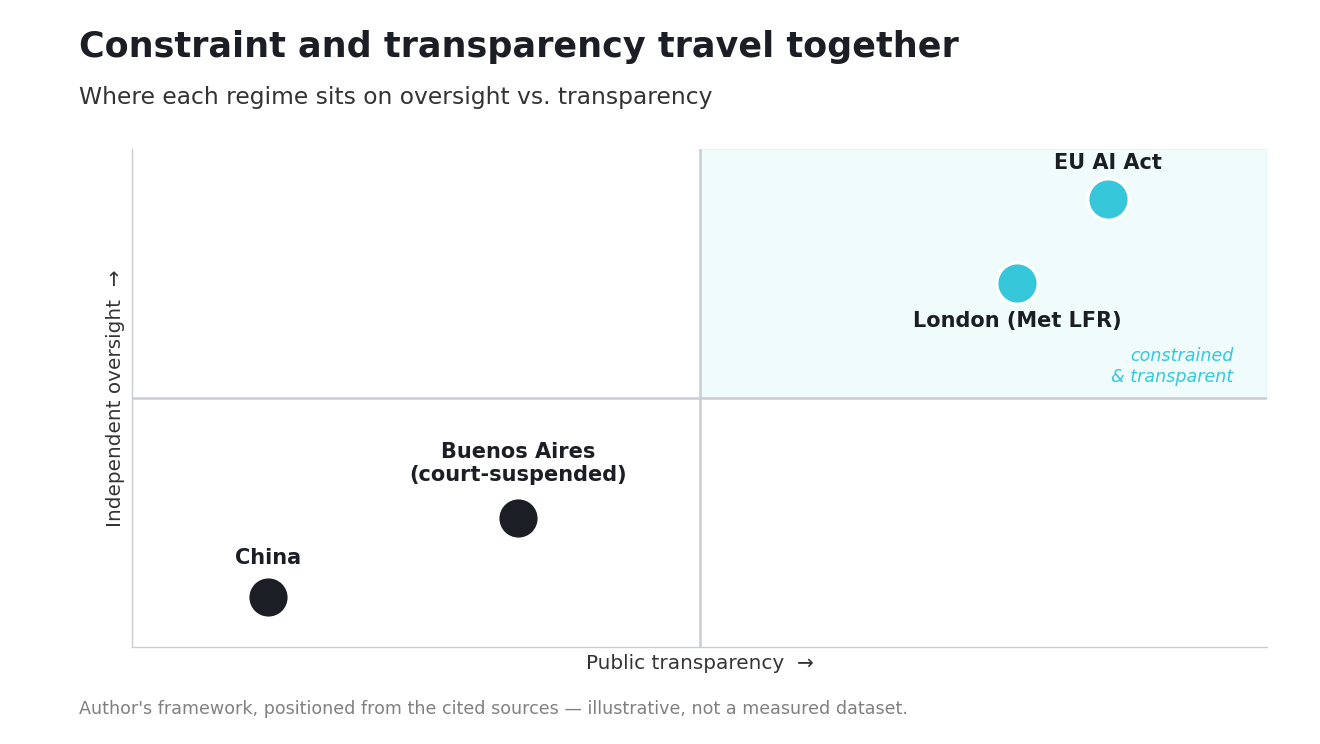
The EU built a default ban on live public facial recognition with narrow, logged exceptions; London now pairs roughly 962 arrests a year with 24-hour watchlists and independent bias testing; Buenos Aires' courts shut a system down until oversight existed; China shows the opposite extreme. The pattern is clear — the “constrained and transparent” model wins on both safety and rights, and America should borrow from it.
By Tom Hanks· June 2026· 9 min read
There's a reflex in American policy debates worth naming out loud, because it quietly shapes this one: the assumption that we are the model, not the student. We invented the modern internet, most of the cameras, and a fair share of the algorithms now pointed at our streets. When the conversation turns to how a free society should govern AI surveillance, the instinct is to reason from first principles, here, as if the question were brand new.
It's an understandable pride, and on plenty of issues it's earned. But sit with a couple of questions before we wave off the rest of the world. If America is the model, why is our law on facial recognition a fifty-state patchwork where your rights flip at the border, while the European Union managed to write a single rule? And why can London tell you exactly how many people its facial-recognition vans arrested last year — and how many it misidentified — while most American cities can't, or won't, tell you either number? The truth the reflex hides is simple: other democracies have already run the experiment we're still arguing about. We don't have to guess at the results. We can read them.
So let's read them. Lay four governments along a spectrum — from the most constrained to the least — and a pattern emerges that should reframe the whole American debate.
The EU: a default "no," with narrow, logged exceptions
At the constrained end sits the European Union's AI Act, which took force in August 2024, with its core prohibitions applying from February 2025.¹ Its approach to live facial recognition in public is the opposite of America's: instead of fifty answers, one rule. Real-time remote biometric identification in public spaces by police is *banned by default.*¹
But — and this is the part Americans on both extremes tend to miss — it is not banned absolutely. The Act carves out three narrow, explicitly listed exceptions: a targeted search for victims of abduction, trafficking, or sexual exploitation and for missing persons; the prevention of a specific, imminent terrorist threat; and the location of a suspect in a serious crime.¹ And each permitted use comes wrapped in procedure: a fundamental-rights impact assessment beforehand, registration in an EU database, prior authorization by a judicial or independent authority for each deployment, and notification to oversight bodies after.¹ The philosophy is not "trust us." It's "here are the only doors, and every time you open one, it's logged." That's a model an American police chief could actually work with — and an American civil-libertarian could actually audit.
London: constrained and counting in public
A notch toward the permissive end sits London, which is more instructive than the EU precisely because it isn't an abstraction — the cameras are running, and the Metropolitan Police publish the box score. Over the year from September 2024 to September 2025, the Met's live facial-recognition deployments produced 962 arrests from 203 deployments, generating 2,077 alerts with 10 recorded false matches.² The watchlists aren't permanent dragnets: each is built for a specific deployment no more than 24 hours ahead and deleted afterward.³ And the underlying algorithm was sent to the National Physical Laboratory — an independent government lab — which found that at the Met's chosen match threshold there was no statistically significant performance gap across gender or ethnicity, though the gap reappeared at the looser thresholds the Met therefore avoids.⁴
Now, honesty requires the asterisk, and it's a revealing one. Of those 10 false matches in the deployment year, eight involved Black people.² The Met argues the sample is too small to be statistically meaningful and reflects where the cameras were deployed; civil-liberties groups dispute that. I'm not going to resolve that fight for you, and I'd distrust anyone who claimed it was settled. But notice why we can even have the argument: because London publishes the numbers. The lab finding and the street data sit in visible tension, and that visibility is the point. Transparency didn't make London's system perfect. It made the imperfection arguable — which is the only condition under which it can be fixed. A system you can't see can't be corrected, only trusted or feared.
And London's discipline wasn't simply chosen; to a real degree it was imposed. In 2020 Britain's Court of Appeal found an earlier police facial-recognition deployment — by South Wales Police — unlawful, faulting the excessive discretion officers had over who landed on a watchlist, an inadequate data-protection assessment, and too little done to rule out racial or gender bias.⁵ That ruling is a large part of why the safeguards above exist at all. It's a useful reminder that the constraints which make surveillance trustworthy are often the ones a court had to force — and that "transparent" regimes usually got that way because someone made them.
Buenos Aires: what happens with the lights off
Drop further down the spectrum, to a system run without those constraints, and you see the failure mode in full. Buenos Aires launched a fugitive facial-recognition system in 2019, meant to match faces against a database of wanted people. By 2022 a court had suspended it and in 2023 an appeals court confirmed the system unconstitutional — after an inspection found authorities had run nearly 10 million queries on some 7.5 million people, including searches on journalists and politicians who were nowhere on any wanted list.⁶ The court didn't ban the technology forever. It barred its use until oversight bodies existed, a bias study was done, and deployments were publicly reported — the very safeguards Europe wrote in from the start.⁶ Buenos Aires is the control group for what "we'll be responsible, trust us" produces when no one is required to keep the receipts: not a careful tool that occasionally errs, but a dragnet that quietly indexed a city.
China: the far end, for contrast
And at the far end sits the case that makes the others look careful by comparison. China's surveillance apparatus operates with no judicial authorization, no public logging, and no independent bias oversight — and in Xinjiang it has been turned to ethnic targeting. Human Rights Watch reverse-engineered the mobile app police use there and found it aggregates everything from electricity use to package deliveries and flags people who match any of dozens of "person types" for investigation, atop mass collection of biometric data across the region's population.⁷ China isn't a different point on the same spectrum so much as the structural inverse of the EU: maximal surveillance, minimal rights, by design. It's the answer to "what if we removed every constraint," and it is not a country most Americans would trade places with.
The pattern, and the better truth
Here's where the spectrum pays off, because it overturns the frame the American debate keeps defaulting to. We argue about surveillance as a straight trade — more safety means less privacy; pick your spot on the slider. It feels like hard-headed realism. But look at the four cases and ask: where did that trade actually hold? The two most constrained systems, the EU and London, are also the ones doing real safety work with public legitimacy intact — London's 962 arrests are not nothing, and they happened inside a framework citizens can inspect.²,³ The two least constrained, Buenos Aires and China, didn't buy more safety with their lost privacy; one collapsed into a civil-rights scandal and a court shutdown, the other into a tool of oppression.⁵,⁶ The slider is the wrong picture. Constraint and transparency aren't the price you pay for surveillance that works — increasingly, they look like the condition for it. A national expert panel reviewing the U.S. landscape reached a compatible conclusion: not "ban it," not "unleash it," but govern it — with transparency, human review, authorization, and equity safeguards.⁸
The lesson for America isn't to copy any one country wholesale — the EU's rule will feel rigid to some, London's cameras intrusive to others, and reasonable people will draw the lines differently. The lesson is narrower and harder to dodge: the countries getting the most out of this technology without losing their citizens' trust are the ones that built the constraints first — the authorization, the published numbers, the independent bias testing, the deletion clocks. America has the cameras already. What it's missing is the paperwork that makes them legitimate.
I'll say plainly where I'm coming from, since this is my field: I work in AI for public safety, and these are my own views. I have a stake in this technology being trusted — and the clearest path I can see to durable trust is the one London stumbled toward and the EU wrote down: let people see the numbers, including the embarrassing ones.
I could be wrong about which specific model ages best; the EU's framework is young, London's pilot is still a pilot, and the next few years will test both in ways no white paper can predict. I don't think I'm wrong about the direction the evidence points: that the choice was never really safety versus rights, but disciplined surveillance versus the undisciplined kind — and only one of those keeps a free society free while it works. The rest of the world has done us the favor of running the trials. The least we can do is read the data before we run our own.
References & Sources
Superscript numbers in the text correspond to the numbered sources below. The quadrant figure is an original graphic by the author — a synthesis positioning each regime on oversight and transparency, drawn from the cited sources, and offered as the author's framework rather than a measured dataset. Several items post-date mid-2025; figures (especially London's) reflect specific reporting periods and may change.
-
Regulation (EU) 2024/1689 (the AI Act), Article 5 (default prohibition on real-time remote biometric identification in public spaces by law enforcement, with three narrow exceptions and authorization, logging, and impact-assessment safeguards); in force Aug. 1, 2024, prohibitions applicable Feb. 2, 2025. eur-lex.europa.eu · European Commission, AI Act overview and dates. digital-strategy.ec.europa.eu · Future of Privacy Forum analysis of the RBI rules (2026). fpf.org
-
Metropolitan Police, "Live Facial Recognition Annual Report" (Sept. 2025): 962 arrests from 203 deployments, 2,077 alerts, 10 false matches (eight of the ten involving Black people; none arrested, six briefly stopped; the Met deems the sample not statistically significant, a characterization civil-liberties groups dispute). met.police.uk · theregister.com
-
Metropolitan Police, official statements on LFR deployments and watchlists (bespoke watchlist created ≤24 hours before each deployment and deleted afterward; cameras active only during deployments). met.police.uk · news.met.police.uk
-
National Physical Laboratory, "Facial Recognition Technology in Law Enforcement: Equitability Study" (NPL Report MS 43, Mar. 2023): no statistically significant demographic performance difference at the operating threshold, with bias reappearing at lower thresholds. science.police.uk
-
R (Bridges) v Chief Constable of South Wales Police [2020] EWCA Civ 1058 (Court of Appeal; police facial-recognition deployment ruled unlawful on privacy/Article 8, data-protection, and public-sector-equality-duty grounds). libertyhumanrights.org.uk
-
Buenos Aires' Fugitive Facial Recognition System (SRFP) ruled unconstitutional (Sept. 2022; upheld on appeal Apr. 2023) after ~10 million queries on ~7.5 million people, including non-fugitives; barred until oversight, a bias study, and public reporting exist. cels.org.ar · fpf.org
-
Human Rights Watch, "China's Algorithms of Repression: Reverse Engineering a Xinjiang Police Mass Surveillance App" (2019); "Mass Surveillance Fuels Oppression of Uyghurs" (2021). hrw.org · hrw.org
-
National Academies of Sciences, Engineering, and Medicine, report recommending federal governance of facial recognition — transparency, oversight, and equity safeguards rather than either a blanket ban or unconstrained use (2024). nationalacademies.org