Energy & AI Infrastructure
Renewable O&M Is a Golden Enterprise Software Opportunity — and the Incumbents Are Going to Miss It
The renewable industry has spent twenty years building assets and almost no time building the software to operate them. The existing players are dashboards. The next layer is agentic. Why this matters now, what changes for asset operators, and the three-year window before category consolidation closes.
By Tom Hanks· June 2026· 13 min read
Editor's note (June 26, 2026): While researching the material for another essay in this series, I realized that — to remain consistent and accurate in what I'm reporting — I needed to update a couple of figures in this piece. Since it was already published online, I'm making this note of acknowledgment about the changes, for reasons of integrity. First, I clarified the fixed-O&M figure: NREL reports utility-scale PV O&M on an AC basis (about $22–24 per kW-AC per year); the ~$16 I originally cited is the same cost expressed on a DC basis, and the text now states both so the source is easy to check. Second, I updated the McKinsey citation to point to the primary report (Renewables O&M Reimagined, May 2026) rather than the secondhand news coverage I first relied on. Neither change alters the essay's argument.
There is a strange asymmetry at the heart of the renewable energy boom. Over the past two decades, the industry has become extraordinarily good at building things. We have planted roughly 2,392 gigawatts of solar across the planet and crossed 5,149 GW of total renewable capacity by the end of 2025.¹ That is one of the largest deployments of physical infrastructure in human history — and we pulled it off in about the time it takes a kid to go from kindergarten to a learner's permit.
And yet the software we use to operate all that capacity would look familiar to a refinery operator from 1995. We poured the concrete and more or less forgot to write the code. We built a fleet of Ferraris and we run them with a clipboard and a spreadsheet named FINAL_v7_actuallyfinal.xlsx.
Twenty years of assets, twenty minutes of software
Renewables treated software as a cost center bolted on at the end — a monitoring portal to prove the plant was on. The result is what I'd politely call the dashboard era — a dashboard that is no more than a very expensive smoke detector that you still have to watch daily as it tells you something is wrong. It does not walk over and put the fire out.
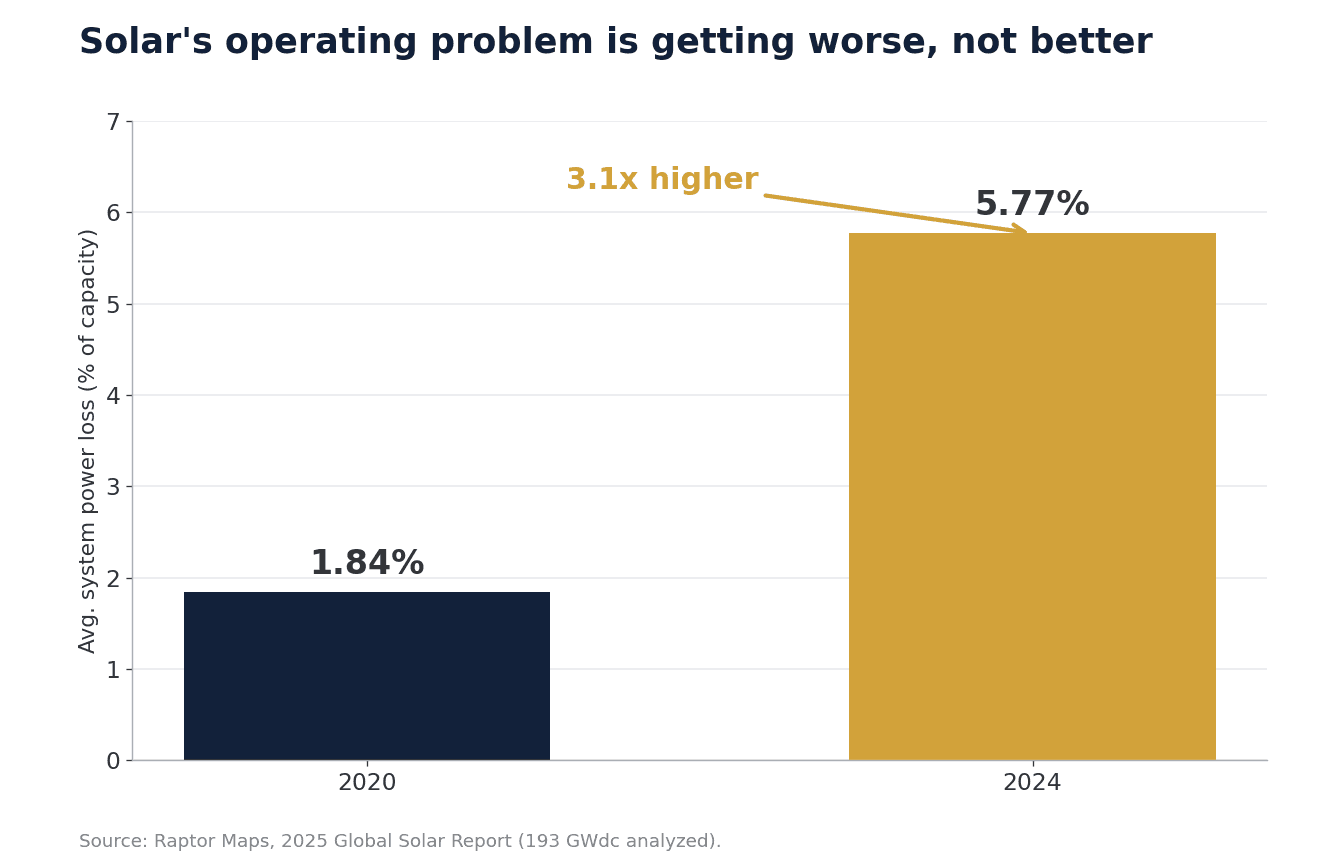
The cost of that gap is no longer theoretical. Raptor Maps, analyzing 193 GWdc of operating solar, estimated the global sector lost as much as $10 billion in revenue to asset underperformance in 2024 — a 15% jump in a single year.² The average system now loses 5.77% of its capacity to faults, up from 1.84% in 2020. As the industry matures, the problem isn't getting better. It's getting worse.
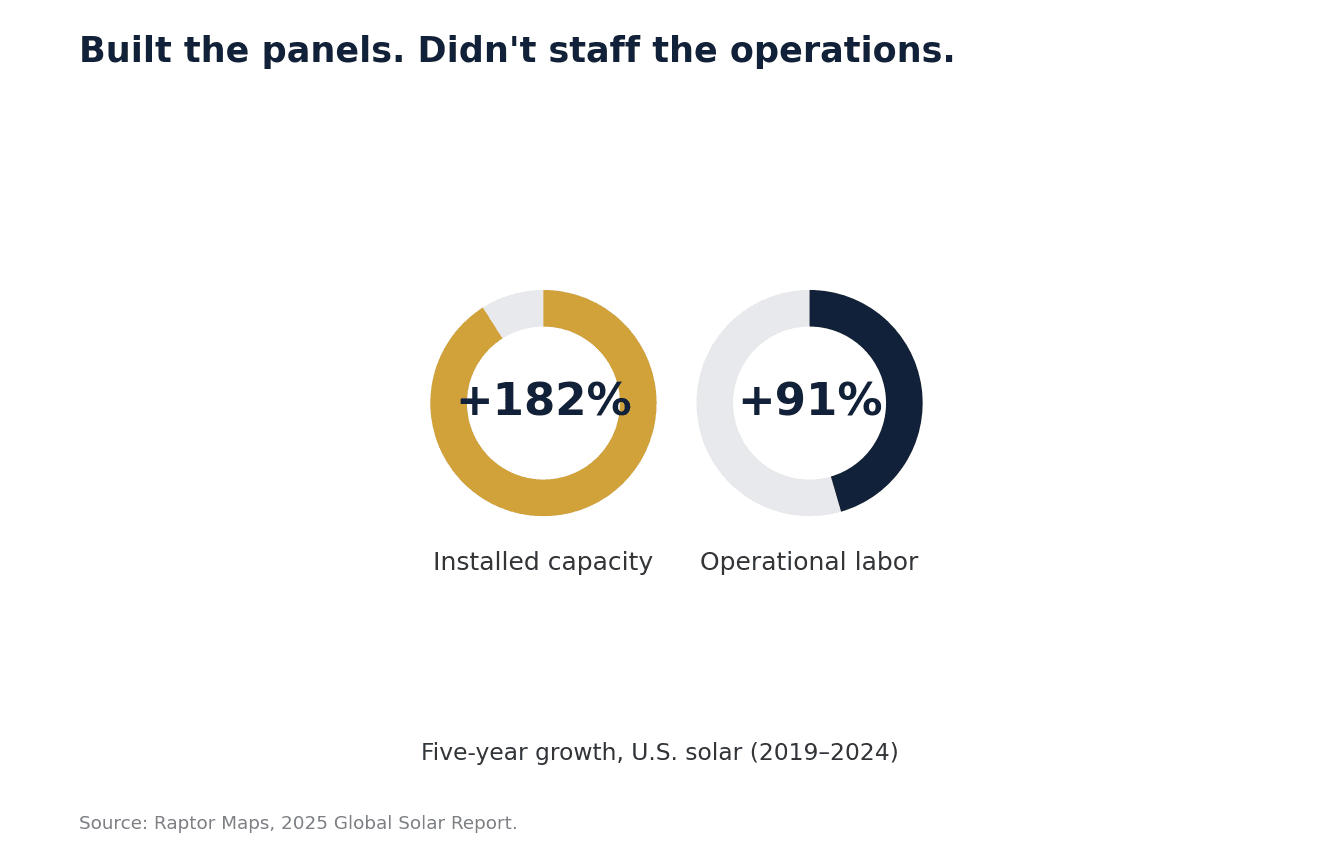
Why worse? Because we are adding assets far faster than we are adding the people to run them. Over five years, U.S. installed solar capacity grew 182% while the operational labor force grew just 91%.² You cannot hire your way across that gap. The arithmetic simply doesn't close — and every new megawatt widens it.
And running them isn't free. Operating a utility-scale plant costs roughly $16 per kW-DC per year (about $22–24 per kW-AC) in fixed O&M,³ and because today's projects are underwritten to run past 30 years,⁴ that line item gets paid again, and again, and again — until lifetime operations rival a meaningful share of what the plant cost to build in the first place. O&M is not the tip you leave after dinner. It's a second mortgage on the asset. And right now most of it is still being managed by hand, which is very costly at scale.
The warranty is only as alive as the company that signed it
Here's a belief almost every asset owner holds, and it's a fair one: buy from a big, reputable installer, sign the warranty, and you're covered for the life of the system. That's how it's supposed to work, and for years it mostly did.
So before we lean on it, three honest questions. What happens to your service contract when the company that signed it no longer exists? If your inverter dies in year 12, who actually picks up the phone? And how sure are you that the firm that sold you the panels is built to still be alive when the hardware finally needs them?
For a lot of owners, those stopped being hypotheticals. Roughly 100 U.S. solar companies have filed for bankruptcy since 2023,⁵ as residential installations fell 31% in 2024 — the first decline in seven years.⁵ When an installer goes under, the manufacturer's hardware warranty often survives — but the part that actually keeps a system producing, the diagnosis and the labor and the truck that shows up, frequently does not. As Fitch Ratings put it, "as installers leave the market, borrowers have less access to maintenance and support for their solar systems."⁵ The panels are fine. The promise to maintain them left with the company.
The deeper truth is that O&M was never safe bundled with the company that sold you the system — because that company's survival has almost nothing to do with whether your inverter keeps running. Tying the two together is like expecting the developer who built your house to swing by and fix the furnace in year 12: the moment the sale closed, you became an afterthought to their business. Which is why even consumer advocates now say the quiet part out loud — EnergySage advises owners to buy maintenance "through separate companies not involved in installing your solar panels,"⁶ so coverage outlives the installer.
That instinct — hand O&M to someone whose entire reason for existing is keeping the asset running — is the right one, and it scales straight up to fleets. A developer's insolvency can strand a utility portfolio just as cleanly as a bankrupt rooftop installer strands a homeowner; the only difference is the number of zeros. O&M belongs with specialists, not with whoever happened to book the sale.
And this is exactly where the software finally earns its keep. What makes a clean handoff possible — to a dedicated O&M firm, or to the next owner after the last one folds — is a complete, trustworthy operating record that any certified party can pick up cold. McKinsey's 2026 renewables benchmarking found that most underperformance comes not from dramatic equipment failures but from everyday operational drag — delayed maintenance, thin crews, poor planning — and put the value of actively optimizing O&M on the order of €3.4 million (about $3.9 million) per GW per year for solar.⁷ An AI layer that watches every device, drafts the work order, and hands the next operator a full history doesn't replace the O&M specialist — it arms one, and makes the handoff cheap enough that orphaning a system stops being the default cost of a company's bad quarter.
The market is real, large, and hiding in plain sight
Here's the part that should make every enterprise software investor sit up. Wood Mackenzie projects non-residential solar O&M spending will reach roughly $15 billion by 2030 — nearly four times its 2020 level.⁸ And the market is gloriously fragmented: Wood Mackenzie tracks around 140 O&M providers, most surviving on thin, services-style margins.⁸
Fragmented, growing, mission-critical, and starved for software. If you sketched the ideal conditions for a new vertical-software category, you would draw exactly this.
Dashboards report. Agents act.
If you run a fleet today, you almost certainly have a monitoring platform you're proud of — and you should be; it was a real advance over flying blind. So before I make my claim, let me ask the uncomfortable questions. When your screen lights up with a fault at 2 a.m., who actually fixes it? How long does that alert glow before a human moves? And if the honest answer is “days, even weeks,” what is the dashboard really for?
The incumbents here — the monitoring portals and SCADA vendors — are very good at showing you data. The trouble is that showing you data is now the easy part. Two failures compound at fleet scale: alarm fatigue, where threshold alarms throw so many false positives that operators learn to ignore all of them — the subject of a companion essay on why operators don't trust AI — and portal sprawl, where each manufacturer ships its own login and watching a mixed fleet means a dozen screens nobody fully reads, which is its own essay on multi-manufacturer fleets. The result is the same either way: the 2 a.m. alert frequently isn't ignored. It's never seen at all.
The next layer is a unified, single-pane-of-glass dashboard and an intelligent agent — one screen that finally collapses the dozen logins into one normalized view worth checking, paired with software that doesn't just notice the inverter tripped, but works out why, attempts the obvious fixes itself, and, when it can't, drafts the work order with the diagnosis already attached, so the technician arrives knowing what they're walking into instead of discovering it on a ladder. Gartner predicts agentic AI will jump from less than 1% of enterprise software in 2024 to 33% by 2028.⁹ That wave is coming for enterprise software broadly, and renewables is one of the most underserved beachheads it could possibly land on.
A necessary dose of humility: Gartner also predicts that over 40% of agentic AI projects will be scrapped by 2027.⁹ Agents that act without explaining themselves get switched off by the first operator they spook. Trust is the whole game — but that's the subject of a companion essay.
Whoever owns the data owns the category
McKinsey's State of AI research finds that data limitations are the number-one roadblock to scaling AI, cited by the large majority of companies.¹⁰ In renewables, the operational data layer — the normalized, trustworthy record of what every device did and why — is the prize. Build that, and the agentic layer has solid ground to stand on. Skip it, and you've got a chatbot guessing at a plant it doesn't actually understand.
This is precisely where the incumbents are structurally trapped. Their business model is the dashboard subscription. Asking them to build the autonomous layer that makes their dashboard obsolete is like asking the smoke-detector company to invent the sprinkler and the firefighter — and to ship it before their own product starts to look quaint.
The three-year window
Vertical software markets tend to consolidate around a category leader, and they do it faster than people expect. 2025 set an all-time record for SaaS M&A — 2,698 transactions, the most ever recorded, with vertical SaaS the single largest category.¹¹ Markets like this don't stay fragmented forever. Those 140 O&M providers and the dashboard incumbents are about to meet a different kind of competitor — one that sells outcomes, not screens.
The window to define that category is roughly three years — not because of one regulation or product cycle, but because the conditions are aligning at once: the asset base is enormous and freshly built, the operating pain is measurable and worsening, the labor gap is structural, and the technology to close it has finally arrived. After consolidation, the category has a leader, and everyone else is selling features into someone else's platform.
The incumbents are going to miss it — and not for lack of brains. The dashboard was the right answer to the last problem, and that is precisely the trap. The hardest move in business isn't seeing the future; it's walking away from the thing that's still working. That's the move in front of them, and most won't make it — which is why the next great enterprise software company in energy is probably one you haven't heard of yet.
What the winner will be built from
So what does the company that defines this category actually look like? Not a prettier screen. The winning architecture will live at the edge, on the plant — an agent that doesn't just track whether a system is running, but watches efficiency and degradation over time, and when something breaks, works out the cause and tries to restore service before anyone is paged. A reboot, a recycle, a firmware push, whatever the fault calls for — attempted autonomously, logged in full, and reported back. When it can't fix the problem itself, it escalates as a work order with the diagnosis already attached, so O&M knows what they're facing before they leave the truck yard. And every attempt, successful or not, becomes training data that makes the next one sharper.
This is the feature that matters most, so let's name it precisely: autonomous remediation — an agent that attempts a real fix without a human in the loop, and then tells you exactly what it did. Not a suggestion engine, not a smarter alert. A fix.
And it isn't science fiction, because the power industry already does exactly this one rung up. On the distribution grid it's a mature, proven discipline — utilities call it FLISR (fault location, isolation, service restoration), and vendors like GE Vernova and Eaton sell “self-healing grid” systems that isolate a fault and reroute power automatically, restoring service to thousands of customers in seconds instead of hours.¹²ʼ¹³ The grid stopped waiting for a human to drive to the problem years ago.
The open frontier is bringing that same closed-loop autonomy down to the plant — to the inverter, the combiner, the tracker — where a fault still waits for someone to notice it, decode a portal, and dispatch a truck. That gap isn't a feature request; it's the standard the agent has to meet. If the grid above it can heal itself in seconds, the asset beneath it shouldn't sit dark for weeks. Anything less isn't an O&M agent — it's a prettier alarm.
Exactly how much downtime that claws back — and what it does to O&M cost and production yield — deserves its own accounting, which is the subject of a companion essay. And it isn't speculative — the architecture falls straight out of everything above: the assets are already in the ground, the labor gap won't close by hiring, and a dashboard was never going to walk over and put the fire out.
If your monitoring platform vanished tomorrow and was replaced by an agent that quietly fixed 80% of what it found and explained the rest — would you miss the dashboard?
If the honest answer is “not really,” then the dashboard era is already over; we just haven't updated the budget yet. I could be wrong about exactly how fast this arrives — but I don't think I'm wrong about the direction. So here's the better question to sit with: if you started fresh today, not from the screen you bought but from the outcome you actually want, what would you build? That's the conversation worth having.
References & Sources
A note on sources: superscript numbers in the text correspond to the numbered sources below. Market-size and loss figures are third-party estimates and, where ranges exist, are presented as such. Figures in this document are original graphics by the author, built directly from the cited data.
-
IRENA, “Near-700 GW Surge in 2025 Proves Renewable Energy Resilience,” April 2026. irena.org
-
Raptor Maps, 2025 Global Solar Report, reported in PV Tech, “Global solar loses up to US$10 billion to asset underperformance in 2024” (4 Mar 2025) — also source for the 5.77%/1.84% power-loss and 182%/91% capacity-vs-labor figures. pv-tech.org Report: raptormaps.com/resources/2025-global-solar-report
-
NREL, 2024 Annual Technology Baseline — Utility-Scale PV. Reported fixed O&M is $22/kW-AC-yr (2023) and $24/kW-AC-yr (2022 base year) — NREL reports utility-scale PV on an AC basis at an inverter loading ratio of 1.34 — equivalent to ~$16–18/kW-DC-yr. atb.nlr.gov
-
Lawrence Berkeley National Laboratory (Berkeley Lab), “Benchmarking Utility-Scale PV Operational Expenses and Project Lifetimes” (project lifetimes now exceeding 30 years; levelized lifetime operating expenses). emp.lbl.gov
-
Harvard Business School, Institute for Business in Global Society, “Roughly 100 U.S. solar companies have gone bankrupt. Here’s why.” (2 June 2026) — ~100 bankruptcies since 2023; U.S. residential installs −31% in 2024 (per Wood Mackenzie); Fitch Ratings on declining access to maintenance. hbs.edu/bigs
-
EnergySage, “What do I do if my solar installer goes out of business?” (updated Jan 2026) — recommends O&M plans “purchased through separate companies not involved in installing your solar panels.” Note: EnergySage is a solar marketplace. energysage.com
-
McKinsey & Company, Renewables O&M Reimagined: Boosting Performance with AI and Conventional Levers (May 2026) — value of actively optimizing O&M estimated at ~€3.4M/GW/yr for solar PV (and >€9M/GW/yr for onshore wind), against a 12–15% performance gap between median and top-quartile portfolios. mckinsey.com
-
Wood Mackenzie, “The solar aftermarket is growing fast — but new entrants could be left in the cold” (non-residential solar O&M to reach ~$15B by 2030; ~140 O&M providers tracked). woodmac.com
-
Gartner, “Gartner Predicts Over 40% of Agentic AI Projects Will Be Canceled by End of 2027” (25 Jun 2025). The same release projects agentic AI in 33% of enterprise software applications by 2028, up from less than 1% in 2024. gartner.com
-
McKinsey & Company (QuantumBlack), “The State of AI.” mckinsey.com
-
Software Equity Group, 2026 Annual SaaS Report (2,698 SaaS M&A transactions in 2025 — a record; vertical SaaS the largest category). softwareequity.com
-
GE Vernova, “What is Self-Healing Grid Technology?” — FLISR-based automatic fault isolation and service restoration on the distribution grid. gevernova.com
-
Eaton, Yukon Feeder Automation Solution (FLISR / “self-healing grid”) — automated fault isolation and power rerouting, restoring service in seconds. eaton.com