Energy & AI Infrastructure
The Four Reasons Solar Operators Don't Trust AI — and What Changes in 24 Months
Trust is the binding constraint on AI adoption in renewable operations, not capability. Asset operators have been burned by analytics vendors promising self-healing and delivering CSV exports. The unlock is edge-deployed agents that act locally and explain themselves.
By Tom Hanks· June 2026· 6 min read
If you want to understand why AI adoption in solar operations has lagged the hype cycle, don't start with the algorithms. Start with the operator who's been burned. Ask anyone running a utility-scale fleet about their last “AI-powered analytics” vendor and watch their face. They were promised self-healing plants. They got a CSV export and a quarterly invoice. Twice.
We like to explain the slow adoption by pointing at the technology — the models just aren't good enough yet. It's a fair instinct, and for a while it was even true. But sit with a few questions. If capability were the blocker, why does the pilot so often succeed and the rollout quietly die? Why do seasoned operators shelve a tool that demonstrably worked in the demo? What if the obstacle was never the model's intelligence, but something far more human? Here's the truth the technologists keep missing: the bottleneck on AI in renewables is not capability. It's trust. And trust, unlike model accuracy, cannot be downloaded.
The pattern isn't unique to solar. DNV, surveying the energy sector, found that nearly half of energy organizations were preparing to integrate AI — while warning that “the engineering community has a high level of risk aversion and low tolerance to error.” DNV's own headline said it best: AI can accelerate the energy transition, but it must first gain the trust of the sector. So let's be specific about why operators don't trust it yet. There are four reasons.
Reason 1 — They've been burned before
The first reason is scar tissue. The expectation-versus-delivery gap in AI is well documented: a landmark MIT Sloan Management Review / BCG study found that seven in ten companies reported minimal or no impact from AI, even as nine in ten called it an opportunity. In solar, that gap has a specific shape — vendors sold prediction and shipped spreadsheets. When your last three “predictive” tools cried wolf, the fourth starts at a trust deficit no matter how good its math is.
Reason 2 — Alarm fatigue taught them to tune software out
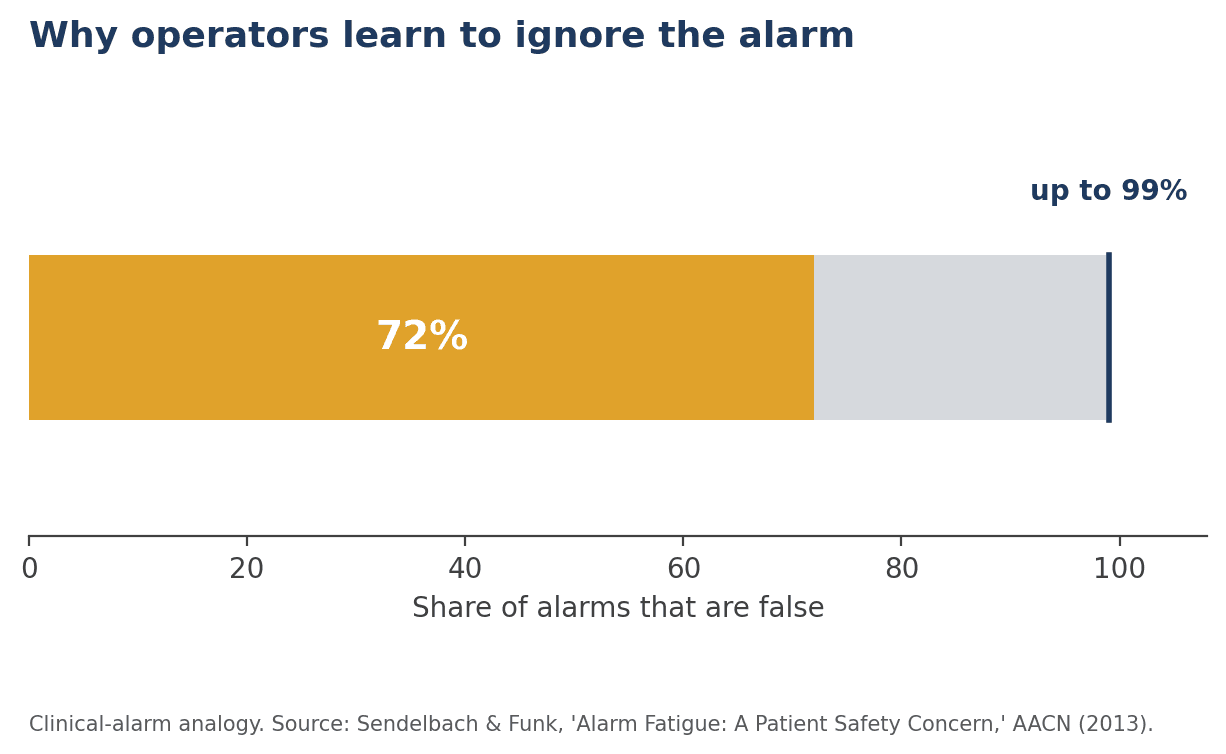
The second reason is that monitoring software has spent a decade training operators to ignore it. Threshold alarms generate a flood of false positives, and humans respond to floods by building dams. The cleanest analogy comes from hospitals, where studies estimate that between 72% and 99% of clinical alarms are false — a problem so dangerous it became a Joint Commission national patient-safety goal. When nearly every alarm is noise, people miss the one that matters. Solar SCADA has the same disease. An AI that piles more alerts onto that heap doesn't earn trust; it earns the mute button.
Reason 3 — The black-box problem
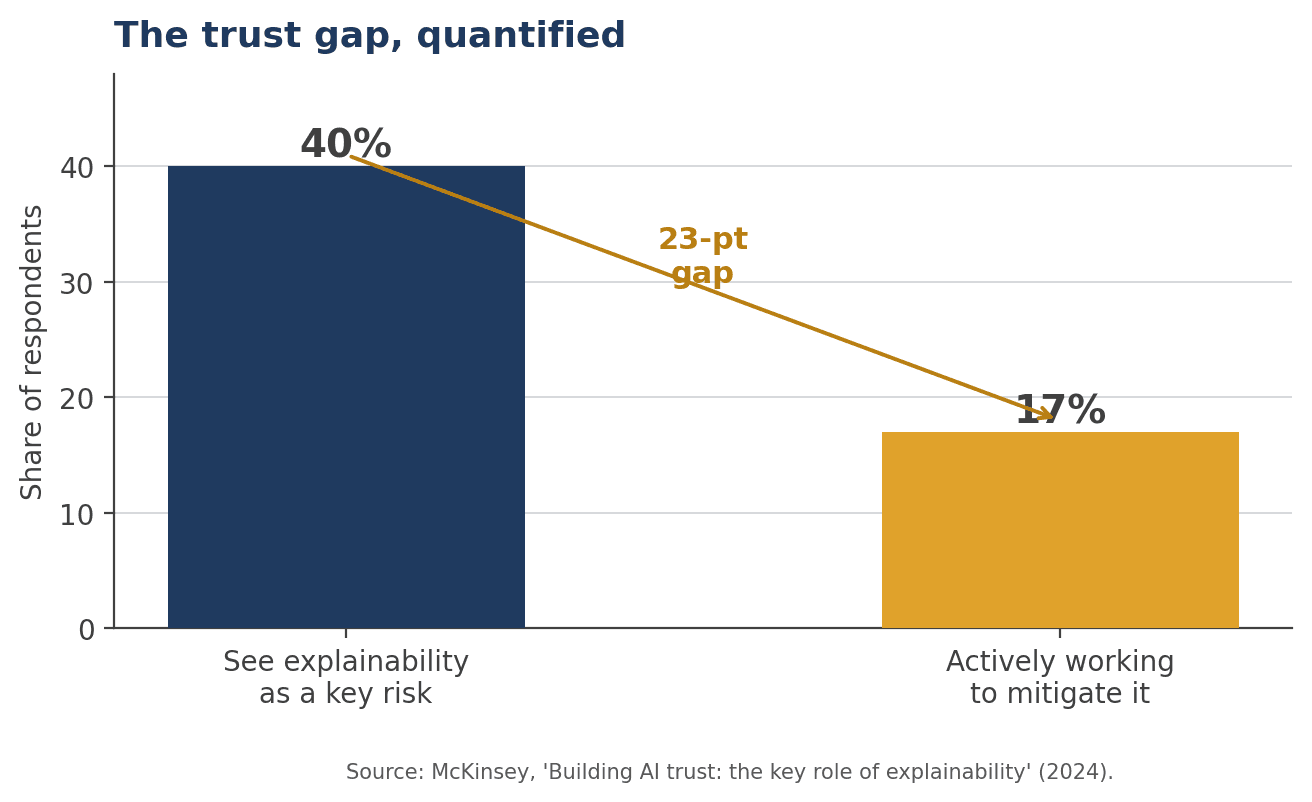
The third reason is explainability. Operators are accountable for physical assets worth hundreds of millions of dollars. “The model says so” is not an acceptable answer when a regional manager asks why you curtailed a site. That's not stubbornness; it's professionalism. McKinsey found that 40% of organizations identify explainability as a key risk of adopting generative AI — but only 17% are doing anything about it. That gap, between knowing trust matters and actually building for it, is the single clearest explanation of why pilots stall.
There's deep research behind this instinct. Two decades ago, human-factors researchers John Lee and Katrina See showed that automation fails when trust is miscalibrated — people either over-rely on systems they shouldn't, or, more often, stop relying on systems that haven't earned it. The academic term is “disuse.” The plain term is “they turned it off.” The U.S. government's own AI Risk Management Framework (NIST) lists explainability as a core characteristic of trustworthy AI for exactly this reason.
Reason 4 — It lives in the cloud, and the plant lives in a field
The fourth reason is architectural. Most analytics products live in the cloud, far from the inverter. They observe; they don't act; and when connectivity hiccups — as it does at a substation in the high desert — they go blind. An operator quickly learns that a system which can only watch, and only when the internet cooperates, is an advisor, not a teammate.
What changes in 24 months
Here's why I think the trust constraint loosens dramatically over the next two years. It comes down to two shifts.
The first is edge. Instead of shipping every data point to the cloud and waiting, the next generation of tools runs the model where the equipment is. Gartner notes a move toward small, task-specific models used far more than general-purpose ones, and the broader edge shift means most enterprise data is now created and processed outside central data centers. Edge-deployed agents act locally — they respond in the seconds that matter, keep working when the link drops, and keep sensitive operational data on-site. An agent that acts is a fundamentally different relationship than a dashboard that reports.
The second is explanation as a feature, not an afterthought. The unlock isn't a more accurate black box; it's an agent that shows its work: “I throttled inverter 14 because its temperature curve matched the last three failures, I've logged a warranty claim, and here's the data.” That sentence — local action plus a plain-language reason — is what converts a skeptic. It's the difference between an oracle and a colleague.
The trust-building sequence
Trust isn't declared; it's accumulated, in a specific order. First, let the AI observe and explain while humans act — so operators can check its reasoning against their own, for free. Second, let it act on the low-stakes, high-frequency tasks where being wrong is cheap and being right is obvious. Third, widen its authority one verified category at a time. Each step pays for the next. Skip a step — hand an unproven system the keys to curtailment on day one — and you don't get adoption. You get the mute button and a very expensive shelf-ware story.
The companies that win renewable AI won't be the ones with the highest benchmark scores. They'll be the ones that understood the assignment was never really about intelligence.
It was about trust — earned locally, explained plainly, one verified decision at a time. The capability is almost here; the trust is the work. I might be early in calling it 24 months, but I don't think I'm wrong about the order — trust is built before it's spent. So carry one question into your next vendor meeting: are they building for your trust, or just for your data? Get that right, and you skip the most expensive lesson in this industry — the one that ends in shelfware and a story about the vendor who overpromised.
References & Sources
Figures are original graphics by the author, built from the cited data. The clinical-alarm range is offered as an analogy, not a solar-specific statistic.
-
MIT Sloan Management Review & BCG, “Winning With AI” (2019).
-
McKinsey & Company (QuantumBlack), “Building AI trust: the key role of explainability.”
-
NIST, Artificial Intelligence Risk Management Framework (AI RMF 1.0), 2023.
-
Gartner, “What Edge Computing Means for Infrastructure and Operations Leaders” (the majority of enterprise data created and processed outside centralized data centers).